
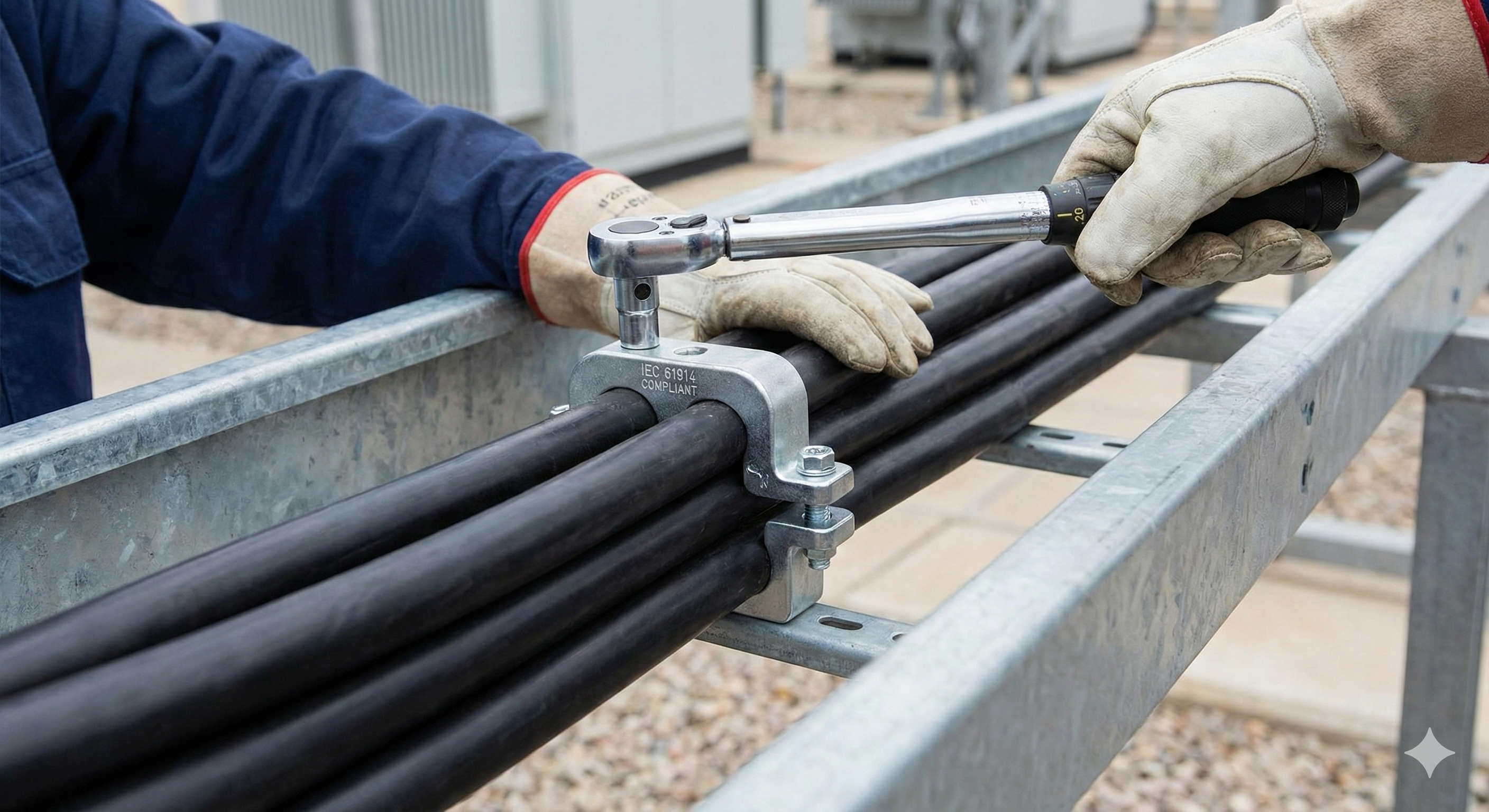
Cable cleats are engineered components, specifically designed to withstand and manage the immense kinetic forces generated during a short circuit event. Failure to install them precisely, adhering strictly to manufacturer specifications and relevant standards, converts a safety system into a catastrophic liability.
If your installation crew treats cleating as a simple tightening task, you are fundamentally misunderstanding the physics involved. We are not just securing cables; we are locking down conductors that may experience outward forces equivalent to several tons per linear meter. This guide cuts the fluff. We focus on the necessary steps to achieve true IEC 61914 compliance and, more importantly, operational safety.
Preparation is Not Optional: Verifying the System Design
Before the first cleat is mounted, three non-negotiable checks must occur. Ignoring this initial planning phase is the primary reason for post-installation failure. You must confirm that the selected hardware aligns perfectly with the validated system design calculations.
The Three Pillars of Pre-Installation Verification
Any veteran knows the installation phase reveals flaws in engineering. Be prepared to reject materials that fail scrutiny.
- Fault Current Validation: The cleat’s required specification hinges entirely on the calculated short circuit fault current (Ipk). Confirm the installed cleat material (e.g., Nylon 6/6, Aluminum) and design load rating meet or exceed the peak mechanical force (Fm) determined by the consulting engineer. Using a cleat rated for 50kA when the system can deliver 100kA is simply unprofessional negligence.
- Conductor Sizing and Type: Cleats are sized for specific cable diameters. Do not rely on visual estimation. Use a caliper. Verify the conductor arrangement (trefoil, single core flat) matches the cleat design. Mixing configurations destroys the cleat’s ability to symmetrically contain the fault forces.
- Hardware Grade: This is where most installations fail. The strength of the cleat is irrelevant if the mounting hardware shears. You must use high-tensile fasteners. We recommend Stainless Steel (A4/316) or robust galvanized steel bolts specified by the cleat manufacturer. Standard hardware store bolts will fail. They are not rated to withstand peak mechanical shock loads.
Installation Sequence: Torque and Spacing Define Success
The mechanical integrity of the entire cable run is dictated by two variables: the precise spacing between cleats and the application of correct torque on the fasteners.
Calculating the Cleat Spacing (Lp)
Spacing is not arbitrary. It is derived from the calculated short circuit force (Fm) and the dynamic strength of the cleat itself.
Standard spacing tables often provide a good starting point, but they are general assumptions. The actual required spacing, Lp, is a function of the system’s peak fault current, the cable size, and the support structure’s rigidity.
- Rule of Thumb: Shorter spacing near power sources or transition points (bends, joints, terminations) is mandatory because mechanical stress concentrates at these locations.
- Transition Management: Where the cable changes direction (a radius bend), you must halve the straight-run spacing immediately before and after the bend. This prevents the cable from whipping out of the support structure.
Securing the Cleat: Torque Is Everything
The correct installation method ensures uniform compression without deforming the cable jacket or damaging the cleat body.
Warning
Do not guess the tension. Over-tightening crushes the cable insulation, leading to premature dielectric failure. Under-tightening allows movement during a fault, causing the cleat body to fracture.
- Use Calibrated Tools: A calibrated torque wrench is essential. Every single cleat must be torqued to the manufacturer’s exact specification. This torque is typically low—often measured in Newton-meters (Nm)—because the primary function is constraint, not crushing.
- Uniformity: If the cleat uses two bolts, apply torque evenly in stages (e.g., 50% torque on Bolt 1, 50% on Bolt 2, then final torque on both). Uneven tightening tilts the cleat, compromising its load distribution capacity.
- Visual Inspection Post-Torque: After applying the final torque, inspect the cable jacket for signs of bulging or deformation. A properly secured cleat grips firmly but leaves the cable jacket structure unimpaired.
The Common Pitfalls That Void Compliance
We have seen countless installations fail certification because of easily preventable errors. These are not minor issues; they represent systemic failures in process control.
Cleat Installation Mistakes to Avoid
- Mixing Manufacturers: Never mix cleat models from different manufacturers on the same run, even if they appear similar. Their tolerance levels, material compositions, and load ratings are distinct.
- The Spacer Misuse: If you are using single-core cables in a trefoil arrangement, the use of internal spacers is often required to maintain separation. Ensure these spacers are correctly oriented and secured before closing the cleat halves. Failure to use the specified internal components renders the certified rating invalid.
- Uncertified Supports: The cable cleat is only as strong as the support structure it is bolted to. Ensure the cable tray, ladder, or strut system is robust enough to handle the calculated forces. A perfectly installed cleat pulling loose from a weak sheet metal tray offers zero protection. Verify the pull-out strength of the anchor hardware in the concrete or steel structure.
- Ignoring Expansion: Thermal expansion of long cable runs (especially high-voltage circuits) must be considered. Leave sufficient slack, or "snaking," in the cable run to allow for movement. The cleat’s job is to stop sudden, violent movement, not to prevent gradual thermal expansion.
Cleating is a specialized mechanical task driven by electrical engineering requirements. By focusing on certified components, calculated spacing, and precise torque application, you move beyond merely strapping down cables and achieve robust short-circuit protection. This is the only acceptable standard.